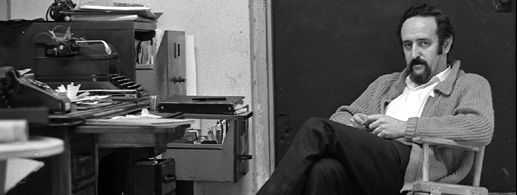

A brilliantly insightful photographer, Robert Otter left his artistic aspirations behind to focus his energies on providing the best life possible for our family. As I've grown older and more aware of the commitment and focus that are essential to the pursuit of artistic expression, his sacrifice has made a deeper and more meaningful impression upon me.
My father passed away in 1986 at the age of sixty, before I had gained enough understanding to recognize the depth of his sacrifice. Up to now the only way I could repay him was to bring everything within my own power to the task of becoming as good a musician as my ability will allow. With the development of internet technology, I'm now able to do much more to introduce people to his artistic vision. I have established this website to exhibit his extraordinary body of work to a public that he was never able to reach during his lifetime.
The collection spans a twelve year period from 1960-1972, and his focus was New York City, particularly Greenwich Village, perceived by many as the "eye of the hurricane" that was the Sixties. I've seen many books and photographs from that incredible time in New York City's history and I believe his work stands with the best of them. My father visually captured a New York City that no longer exists. The Village was a vibrant, Bohemian, artistic community.Life in Greenwich Village during those years was incredibly vivid, and has become even more so by the passage of time. This was one era that not only lived up to its legendary status, but actually surpassed it. Just like a carnival provides a place for the various misfits, rugged individualists and uniquely talented folks who inhabit it, the Greenwich Village of the Sixties was both a Mecca and a haven for an unusual assortment of families, artists, counter-culture types, philosophers, working folks and various oddballs. My parents frequented the various specialty shops, restaurants, clubs and hangouts that have become authentic folklore. These included a place called Art Foods (run by Igor and Sonia Sudarsky, a pair of holocaust survivors), the 9th Circle on 10th Street, and the original Max's Kansas City. They knew such notables as Willem de Kooning, David Amram, Larry Rivers, Paul van Hoeydonck, Jan Yoors, Pierre Gaisseau and Avinash Chandra, among many more. They were also a part of the remarkable art scene on 57th Street during those same years.